
APPLIED OPTOELECTRONICS: +258% UPSIDE - SECOND PICK ON THE DISRUPTIVE INVESTOR
Artificial intelligence is, at its core, a bandwidth problem: petabytes racing between thousands of GPUs in milliseconds, twenty-four hours a day, all encoded in light.

Ten days ago, I published my first conviction on The Disruptive Investor: Planet Labs. It is already up +12.7%.
Today, I publish my second. Applied Optoelectronics : a top 10 holding in my fund across 35 positions, where I see upside of +258%.
Here is the case.
I. THE AI OPTICAL SUPERCYCLE
Every AI cluster that Microsoft, Google, Amazon, or Meta brings online requires tens of thousands of optical transceivers to function.
Without them, their Nvidia GPUs sit idle : the hardware is only as powerful as the pipes connecting it.
The industry has a name for this: the AI optical supercycle.

The numbers reflect the scale of what is coming. The global optical interconnect market stood at $16.1 billion in 2024. By 2030, Grand View Research projects it reaches $34.5 billion, a 14.1% annual growth rate.
The AI specific slice is moving faster still, as shown in the chart below: from $3.75 billion in 2025 to a projected $18.36 billion by 2033, a 21.9% CAGR driven almost entirely by GPU cluster buildout (DataM Intelligence).
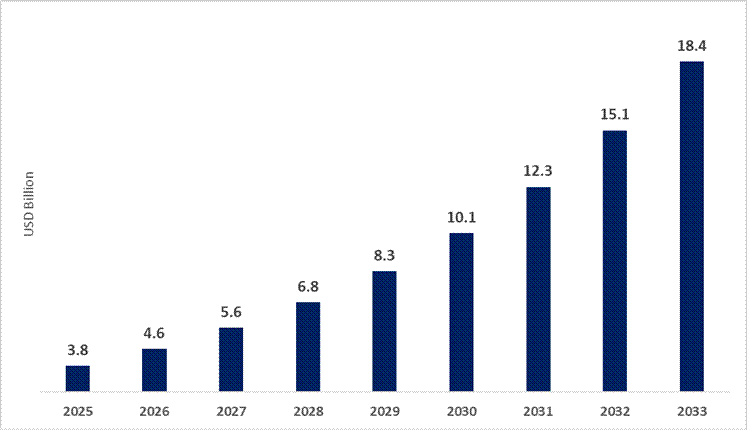
Zooming out, the numbers become even starker. TechInsights puts cumulative AI data center optical spending at $84 billion through 2030, as the industry transitions from 400G and 800G toward 1.6T and 3.2T architectures, and projects optical transceiver shipments to more than quintuple over the same period.
One metric will determine who captures that spending: bandwidth per watt efficiency. The companies that lead on that dimension win the long-term contracts.
Needless to say, copper is no longer a solution. It cannot sustain the signal integrity, the distances, or the power efficiency that modern AI infrastructure demands. In a rack-dense supercluster, copper generates heat and introduces latency that measurably degrades training throughput.
Optical eliminates both.
Every hyperscale data center built from 2025 forward is optical by design, not by choice.
The pipes have already changed. The question is who supplies them. Applied Optoelectronics is making a credible claim to that role.
The critical speed transitions are:
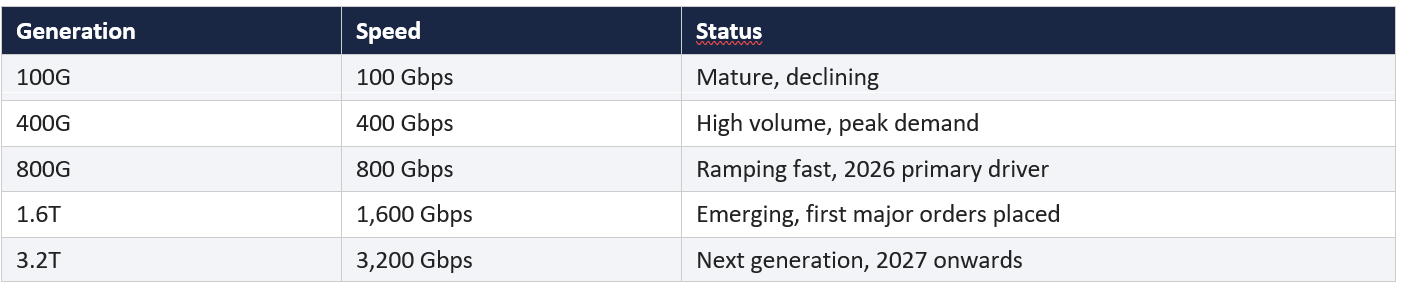
Applied Optoelectronics (AAOI) is qualified and shipping across 400G, 800G, and is under qualification for 1.6T. The ramp is happening now.
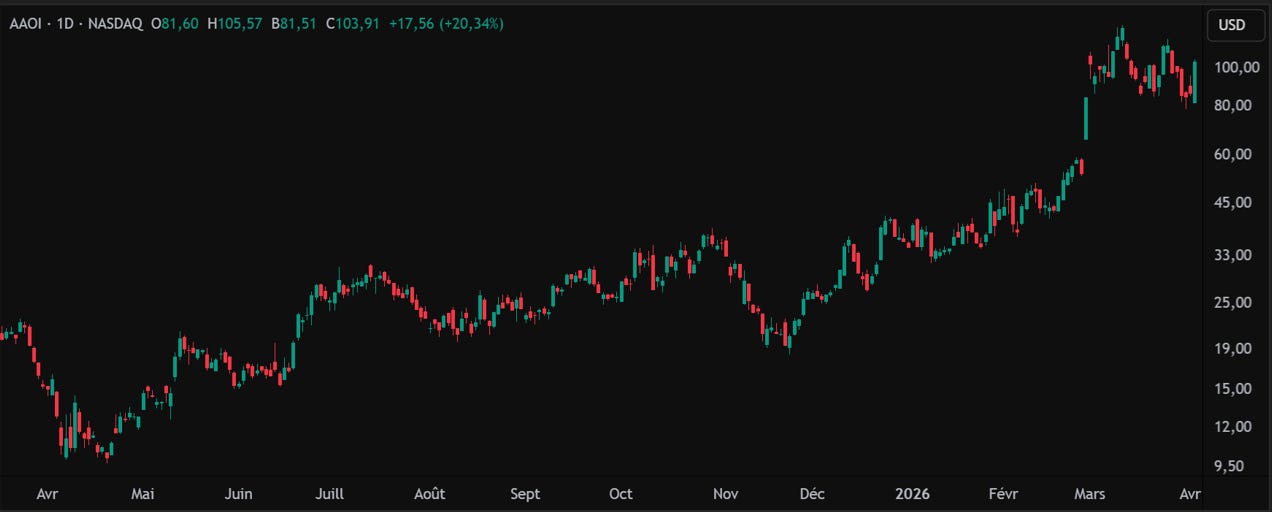
Over the past twelve months, AAOI shares have already risen +902%, as the charts below show. Yet, as the analysis that follows makes clear, the upside potential from here remains substantial.
II. APPLIED OPTOELECTRONICS: THE VERTICALLY INTEGRATED DISRUPTOR
Origin and Structure
Applied Optoelectronics was founded in 1997 by Dr. Thompson Lin, a laser physicist who built the company from scratch in Sugar Land, Texas.
The address matters less than the decision he made at the outset: to manufacture the laser chips in house, not buy them. That single choice separates AAOI from virtually every competitor in the optical transceiver industry.
Most transceiver companies are assemblers. They source core photonic components externally, bolt them together, and compete on price.
AAOI builds from the wafer up. The result is a structural cost advantage at scale, lead times that third-party-dependent rivals cannot match, and intellectual property that cannot be replicated by companies that never owned the manufacturing process in the first place.
This is also what makes AAOI credible when hyperscale customers demand aggressive delivery commitments.
Management has confirmed plans to triple laser manufacturing capacity at the Texas facility, including in-house production of indium phosphide, a substrate so critical to laser performance that most competitors have no choice but to source it externally.
The footprint now spans Sugar Land, Texas (headquarters, wafer fab, and the core of the operation) alongside facilities in Taipei and Ningbo, and R&D anchored in Atlanta.
In March 2026, AAOI announced a new 210,000 square foot U.S. facility. It is the largest domestic production expansion by any AI-focused transceiver manufacturer in the country.
The capacity build has begun.
Product Portfolio
AAOI serves four end markets:
• AI / Hyperscale Data Centers: 400G, 800G, 1.6T transceivers for GPU cluster interconnects. Now the dominant and fastest-growing segment.
• Cable Television (CATV): 1.8GHz amplifiers and optical nodes for broadband upgrades. Recurring, high-margin revenue stream.
• Telecom: Optical components for 5G backhaul and fronthaul infrastructure.
• Fiber to the Home (FTTH): Access network components.
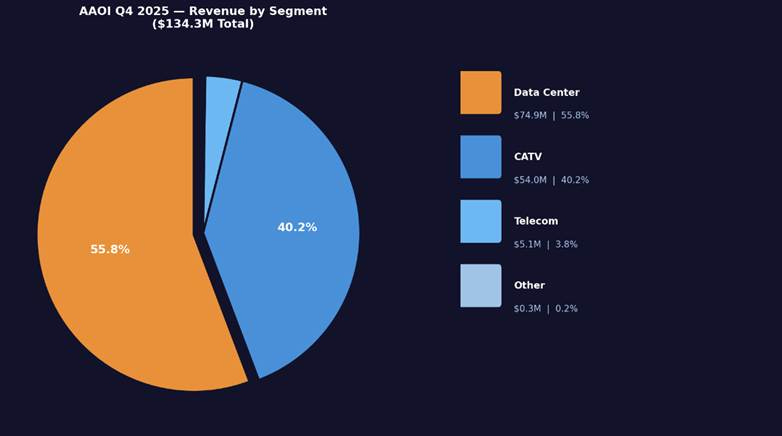
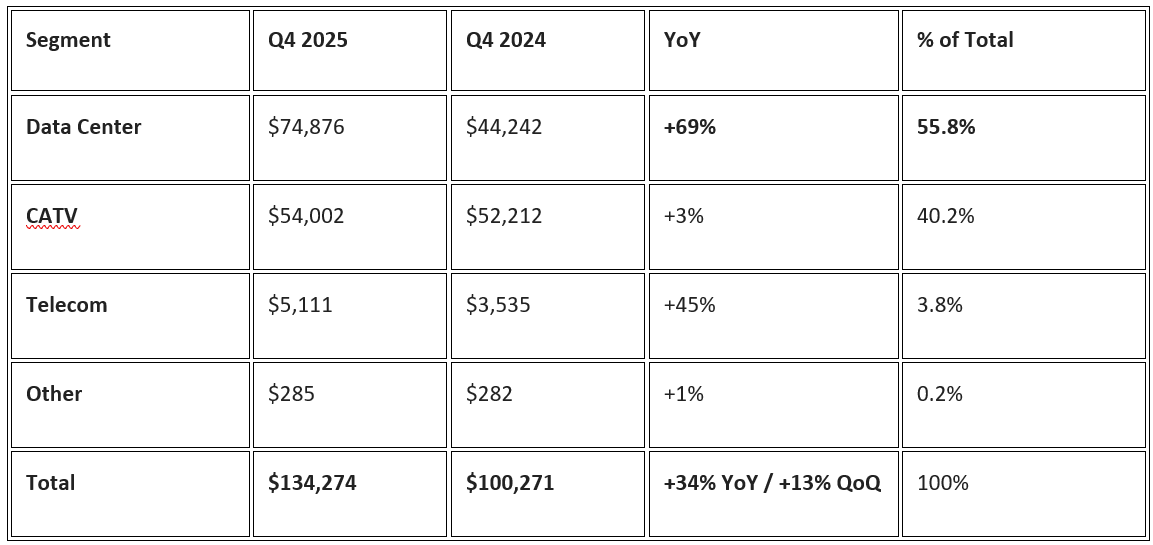
The data center pivot is complete: at 55.8% of total Q4 revenues, it is now AAOI’s dominant segment, driven by 400G transceivers (+141% YoY) and early 800G volumes. CATV ($54.0M, +3% YoY) remains a high-margin, recurring anchor representing 40.2% of Q4 revenues.
All figures in $thousands from the official income statement:
Key P&L Metrics
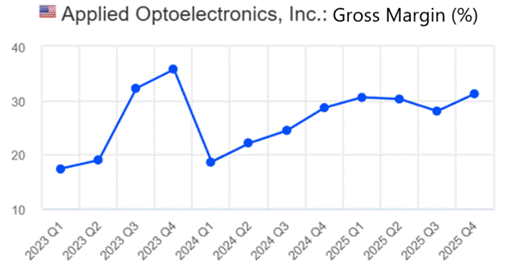
GAAP gross margin expanded to 31.2% in Q4 2025, up from 28.7% in Q4 2024 and 28.0% in Q3 2025.
GAAP net loss narrowed sharply to $2.0M ($-0.03/share) vs. $119.7M ($-2.60/share) a year earlier (the Q4 2024 figure was distorted by a large non-cash charge).
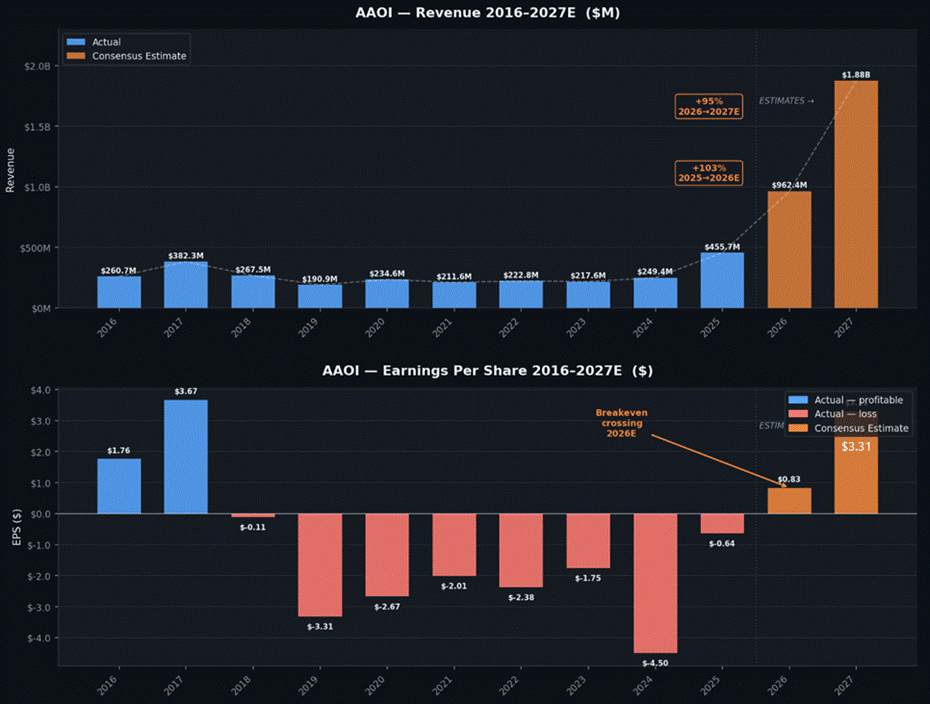
Full-year 2025 GAAP EPS was $-0.64, a dramatic improvement from $-4.50 in 2024.
Q1 2026 guidance: $150M–$165M revenue (vs $145.72M consensus), with non-GAAP EPS ranging from $-0.09 to breakeven.
Capital Structure
As of December 31, 2025, total assets stood at $1,17B — more than double the $547M a year prior. The balance sheet is equity-dominant:
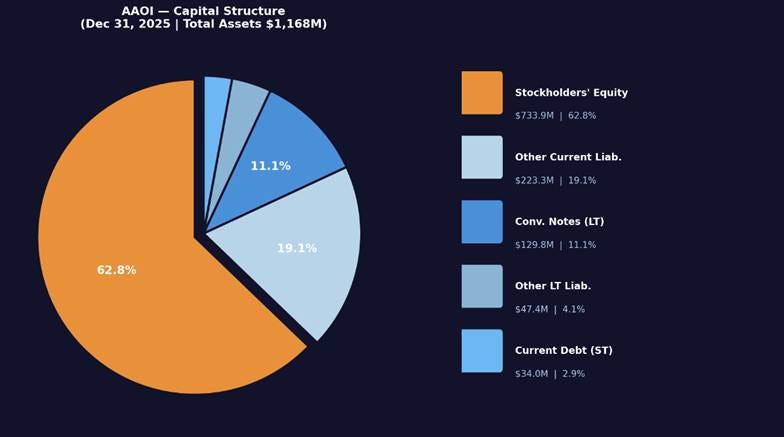
Cash, cash equivalents and restricted cash stood at $216 million at end of Q4 2025, nearly tripling from $79 million a year earlier, with a current ratio of 2.6x — reflecting a balance sheet that is comfortably liquid.
Recent Order Momentum — A Step-Change in Customer Broadening
The month of March 2026 produced a sequence of major hyperscaler wins that carry the potential to add at least $253 million to AAOI’s revenue prospects this year, while simultaneously reducing the customer concentration risk that had been a primary concern for institutional investors.
1.6T order ($200 million+, early March 2026): AAOI revealed this as the “initial order” for 1.6T transceivers from a long-term major hyperscale customer, with full delivery expected within the fiscal year pending product qualification. The scale and framing as “initial” carries a strong signal: more orders from this customer are anticipated as cluster rollouts expand across regions.
First 800G order ($53 million, March 23, 2026): The same hyperscale customer awarded an additional volume order for 800G single-mode transceivers. Delivery is expected to begin in Q2 and complete by mid-Q3 2026.
Second 800G order ($71 million, early April 2026): A further order for 800G transceivers from the same customer was announced shortly after, bringing this customer’s combined orders since mid-March to $124 million in 800G alone. Management confirmed delivery of the second batch by year-end.
CEO Dr. Thompson Lin also confirmed that “the first 10,000 units of an 800G single-mode transceiver order” had already been shipped to a separate hyperscale data center customer — the first public confirmation of transceiver revenue from a second hyperscale name.
The cumulative picture is significant. Three order announcements in under thirty days. Two confirmed hyperscale customers. Combined backlog additions exceeding $250 million in a single month.
Microsoft and Oracle were already known as major customers. The weight of evidence points strongly to Amazon Web Services as the newly re-engaged primary hyperscaler, a thesis supported by two structural facts:
- AWS publicly acknowledged that the majority of its network was still on 400G at the end of 2025, making an 800G and 1.6T upgrade mandatory; and
- AWS holds an active share warrant with AAOI that it may be executing upon as purchases scale.
Patent Portfolio
AAOI considers its patent estate a core strategic asset and enforces it aggressively.
As of December 31, 2024, the company held 188 issued U.S. patents, 137 patents issued across China and Taiwan, and 10 European patents: a portfolio spanning 100G, 400G, and 800G transceiver architectures across four major jurisdictions.
The company has begun translating that portfolio into legal action. In November 2024, AAOI filed patent infringement suits against Eoptolink Technology USA and Accelight Technologies, both competitors whose products are alleged to infringe core transceiver IP.
These cases, filed in the U.S. District Court for the Northern District of California, signal something beyond routine IP housekeeping. They reflect a deliberate decision by management to defend the margins that vertical integration has built, specifically against low-cost Asian assemblers whose competitive model depends on replicating, rather than inventing, the underlying technology.
Management: The Founder Advantage
Founder Dr. Thompson Lin remains Chairman, President, and CEO. Stefan Murry serves as CFO and Chief Strategy Officer. Founder-led companies with vertical integration models and active IP enforcement are structurally harder to disrupt. This management continuity is a material asset.
III. VALUATION — THE CASE FOR $372.00 (+258%)
Current Financial Snapshot
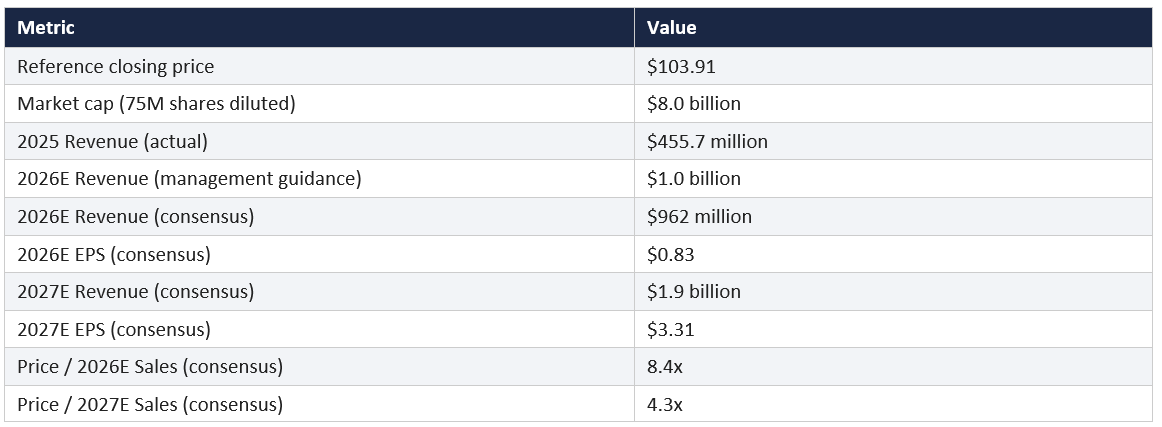
Management has guided to $1 billion in revenue for 2026, implying 111% top line growth. The consensus at $962 million is 4% below management’s own projection, reflecting residual investor skepticism inherited from the execution gaps of 2016 to 2017.
Nevertheless, the current order backlog adds a layer of visibility that substantially de-risks the revenue path. Consensus then expects revenue to nearly double again in 2027, rising a further 95% to $1.876 billion.
Peer Comparison — Where the Multiple Should Trade
Lumentum is the most expensive stock in the peer group, and for good reason: 65% annual growth commands a premium. At 12.3x forward revenue, the market is paying up for execution.
Meanwhile, AAOI is expected to deliver 95% revenue growth in 2027E — materially superior — yet trades at 4.3x. Less than half the multiple, for nearly double the growth rate. This divergence is not fundamentally justified, neither by growth nor by profitability metrics.

The execution overhang from the 2016 to 2017 cycle is a legacy discount that the current order book is actively dismantling.
Price Target Construction — $372.00
Primary Method: Forward Revenue Multiple Rerating
The argument for a rerating to a premium forward revenue multiple rests on three pillars:
1. Revenue growth of 95% in 2027E materially exceeds Lumentum’s 65%, yet AAOI trades at less than half Lumentum’s multiple
2. Vertical integration provides cost and lead time advantages that become increasingly valuable as capacity constraints tighten across the sector
3. Customer broadening from two to three hyperscale names reduces the concentration discount
Applying a 11x multiple to consensus’ 2027 estimate of $1.9 billion:
$1.9 billion × 11x = $20.9 billion market cap
$20.9 billion divided by an estimated 100.6 million shares (derived from the 3-year historical dilution trend of 29.3% per year) yields a 12-18 months price target of = $205.00 per share
Assuming an annualized revenue growth rate slowing to 50% between 2027 and 2031, a price-to-sales ratio of 11x, and the same share dilution trend of 29.3% per year— a hypothesis that remains conservative given that profitability is now on the horizon —, the 5-year price target comes to $372.00 per share, implying a potential upside of +258%.
This multiple (11x) remains 11% below Lumentum’s current 12.3x despite delivering nearly double Lumentum’s revenue growth. The discount is preserved deliberately to account for execution risk on the capacity ramp.
Secondary Method: 2028E EPS Discounted
At $6.45 EPS in 2028 (based on a revenue growth trajectory slowing to +70% Y/Y, under a conservative scenario that assumes no operating leverage and therefore no margin expansion) applied to a 35x multiple appropriate for a profitable, high-growth infrastructure company:
$5.63 × 35 = $197.00 in 2028, discounted two years at 15% = $149.00 on a 6-12 months horizon
Here, I use a 15% discount rate as the required rate of return, combining a 9% cost of equity with an additional 600 basis points of size, volatility, and execution risk premia appropriate for AAOI’s profile.
This secondary method produces a more conservative figure, reflecting the earnings ramp timeline, and still stands +43.4% above Friday's closing price.
Meanwhile, the revenue multiple approach is in my opinion the primary methodology given that AAOI is at a revenue inflection point i.e., not yet a mature earnings compounder.
Price Target: $372.00 | Upside: +258% | Rating: BUY
Capacity Ramp: The Execution Pivot
The single most important variable in the investment case over the next twelve months is the production ramp from 90,000 units per month (800G, end of 2025) to more than 500,000 units per month (800G and 1.6T combined, end of 2026). This is a 5.5x increase in manufacturing output.
Capital expenditure deployment has already accelerated visibly, a direct response to management’s recognition that execution gaps in 2016 to 2017 cost the company both contracts and credibility.
Indium phosphide production is being tripled at the Texas facility. The new 210,000 square foot Sugar Land building is under construction.
These are not plans — they are already funded commitments.
IV. CONCLUSION
Applied Optoelectronics occupies a structurally privileged position at the intersection of two irreversible forces: the AI infrastructure buildout and the mandatory upgrade cycle from 400G to 800G and 1.6T optical networking.
The company’s vertical integration model — manufacturing its own indium phosphide laser chips in Texas — gives it cost advantages, delivery speed, and IP protection that pure assemblers cannot replicate. The patent enforcement actions of 2024 underscore management’s intent to defend those margins aggressively.
The order momentum of March and April 2026 — exceeding $250 million in new backlog in under thirty days across both 800G and 1.6T — is not a one-off event. It reflects a structural ramp driven by hyperscale customers who have committed to AAOI as a primary optical supplier for GPU cluster buildout.
The addition of a second confirmed hyperscale customer broadens the revenue base and begins to address the concentration concern that previously justified a discount to peers.
At $103.91, AAOI trades at 4.3x consensus 2027 of $1.9 billion in revenue. Lumentum, growing at roughly half AAOI’s rate, commands 12.3x. The convergence of these multiples is not a guarantee — it requires execution.
But the order book is real, the capex is deployed, and the manufacturing expansion is underway.
Price Target: $372. Upside: +258%. Rating: BUY.
The primary risk remains the pace and quality of the capacity ramp. Until management provides detailed 2026 capex guidance, maintaining a full position requires conviction in the vertical integration model and in the demonstrated ability to win and deliver on hyperscale contracts. That conviction is supported by the evidence available today.
V. RISK FACTORS
Customer concentration. Microsoft, Oracle, and the newly engaged hyperscaler represent the bulk of current revenue. Any slowdown in AI capex from one of these three names would have an outsized near-term impact.
Product qualification delays. In February 2026, AAOI encountered validation issues getting its 800G transceivers qualified on Microsoft’s network, delaying recognition of $4 to $8 million in revenue. While such delays are common across the industry — hyperscale networks deploy a wide array of GPU and XPU architectures that each require transceiver re-qualification — investors should monitor qualification timelines as a leading indicator of revenue recognition.
Execution on the capacity ramp. A 5.5x increase in manufacturing output over twelve months is operationally aggressive. Quality yield, equipment lead times, and workforce scaling all represent potential sources of delay. Management has not yet communicated detailed 2026 capex guidance — this remains an open item to watch closely.
Competition. Coherent’s multi-billion dollar NVIDIA partnership and Lumentum’s silicon photonics capabilities represent serious competitive pressure at the high end of the product stack. AAOI must sustain its cost and lead-time advantages through the 1.6T and 3.2T transitions.
Geopolitical and tariff risk. AAOI operates manufacturing in Taiwan and China. US-China trade tensions and tariff escalation on Chinese-manufactured components could affect the cost structure and supply chain reliability.
Market skepticism. The stock has gained approximately 200% year-to-date and has traded in a $80 to $128 range over a single month. Significant volatility is likely to persist as the market continuously reprices execution probabilities against the order backlog.
This report is produced for informational and educational purposes by The Disruptive Investor. It does not constitute investment advice, a solicitation, or a recommendation to buy or sell any security. The author may hold a position in Applied Optoelectronics (AAOI). Every investor remains solely responsible for their own investment research and decisions. Past performance is not indicative of future results. All information and opinions included in this document are subject to change and may be modified without notice. Read the full Disclaimer here. Sources: Grand View Research, DataM Intelligence, TechInsights, Zacks Investment Research, FactSet, TradingView, StockTitan, SimplyWallSt, Applied Optoelectronics investor relations.